CEO Welcome Speech at QSMC Forum 2026
At the QSMC Service Leaders’ Session, Tax Academy CEO Dennis Lui explores how professional learning, human connections and sound judgment build trust in the age of AI.
From Classrooms to Connections: Building the Trust That Makes Singapore Work – “Just Listen”
QSMC Service Leaders' Session – “Where AI Meets Trust”
19 November 2026
Good morning, everyone. Welcome to Tax Academy, and to our new Tax Academy Hub.
Let me begin with a question: who is responsible for a good public-service experience?
We think of public officers. But imagine a business owner trying to understand a tax obligation.
Often, the first person they approach is an accountant, a finance manager or a software provider.
If that person gives sound guidance, the business owner may never need to contact IRAS. If the guidance is wrong, even an excellent government service cannot prevent confusion.
Some of the people who shape the quality of public service don’t work in government at all.
The service journey, in other words, begins long before someone visits our website or calls our hotline. It is shaped by people and organisations beyond our own.
That is why Tax Academy matters.
Building capability beyond government
Established by IRAS 20 years ago, Tax Academy brings together professionals from government, industry and academia.
I describe our work in three phrases: know-what, know-how and know-who.
Know-what is understanding the rules. Know-how is applying these rules. And know-who is finding expertise and connecting with people who can help solve unfamiliar problems.
Today, an AI system can produce a polished explanation of a complex tax issue in seconds. But sounding confident does not mean correct. The harder skill becomes knowing which answer deserves our trust, amidst all the various possibilities.
That is why we emphasise practitioner-led teaching and real cases. Ask sharp questions: What fact would change my conclusion? What evidence should I check? These are habits of judgment.
What Tax Academy is doing
Let me share four recent examples, which go beyond core tax courses for tax professionals.
First, international financial transparency.
One important way we identify learning needs is through our ongoing engagement with the tax ecosystem. By speaking with industry and professional practitioners, we hear directly about the challenges they face, what they find confusing and where they need help.
For example, we heard from various parties about the need for training on FATCA (Foreign Account Tax Compliance Act by the US) and CRS (Common Reporting Standard developed by OECD). These are international frameworks designed to promote tax transparency and compliance.
We assessed the demand and partnered with a Big 4 accounting firm to roll out this programme. Seats filled so quickly that we had to open a second class.
The wider lesson here is that our ecosystem helps us listen, discover problems and identify opportunities to serve better. In this case, the demand pointed to a real business and compliance need. Professionals must learn how to interpret difficult or unusual accounts, and document their decisions; and not just learning the rules.
Second, intangibles.
A study by Ocean Tomo, an established American intellectual property valuation firm, estimates that the intangible component of S&P 500 companies’ market value has grown to 92% in 2025, from just 17% in 1975 – a 75% inversion! – Now, this doesn’t mean all this intangible value can be attributed to patents or trademarks. (There could be other sources of business value).
But it tells us something profound. The way businesses create value has changed enormously. And this creates new challenges for intellectual property, valuation and taxation – precisely why Tax Academy brought these disciplines together.
With IPOS International, we ran a three-day masterclass in October, built around a continuous business case. We have explored AI applications in IP, valuation and tax with IPOS and the Institute of Valuers and Appraisers, including where machine-generated analysis needs human scrutiny.
Third, international tax research.
We have set up the Singapore Tax Academy Research Initiative, a collaboration with the Yong Pung How School of Law at SMU. We connect academic research with the real questions confronting policymakers and practitioners, including digital taxation and global minimum taxes.
In October, we hosted an international conference in collaboration with the International Fiscal Association (IFA) Singapore Branch, where we featured some of the top international tax professors in the world. (Professor Wolfgang Schön, Professor Pasquale Pistone and more).
Fourth, digital learning.
We launched TaxTOC, our on-demand learning platform, so expertise and discussions can reach learners beyond this room. This will also facilitate overseas learners to have easier access to our programmes.
The Tax Academy Hub
That brings me to this Hub, which opened in July.
We hope that this becomes a hub where practitioners, public officers, academics and international colleagues can encounter new ideas and make new connections in one cosy space.
The irony of the AI age is this – we are more connected than before (think of social media, instant messaging) yet we are also more isolated and even living in silos and echo chambers. Hence, today, face-to-face interactions across disciplines and boundaries become even more critical.
Where AI meets trust
Let me conclude. The song, The Sound of Silence – Paul Simon wrote the song more than 60 years ago. Think back to 1963 – did you know Television Singapura started broadcasting that year?
There is a line:
“People hearing without listening.”
Today we can generate answers in seconds, produce reports, analyses and presentations almost effortlessly. But does that make us wiser?
Are we Hearing without listening?
Reading without understanding?
Trusting without questioning?
Technology can help us find answers. People must still take responsibility for what they do with them.
So, to end my speech, perhaps we can do one simple thing together.
Just listen.
This is The Sound of Silence.

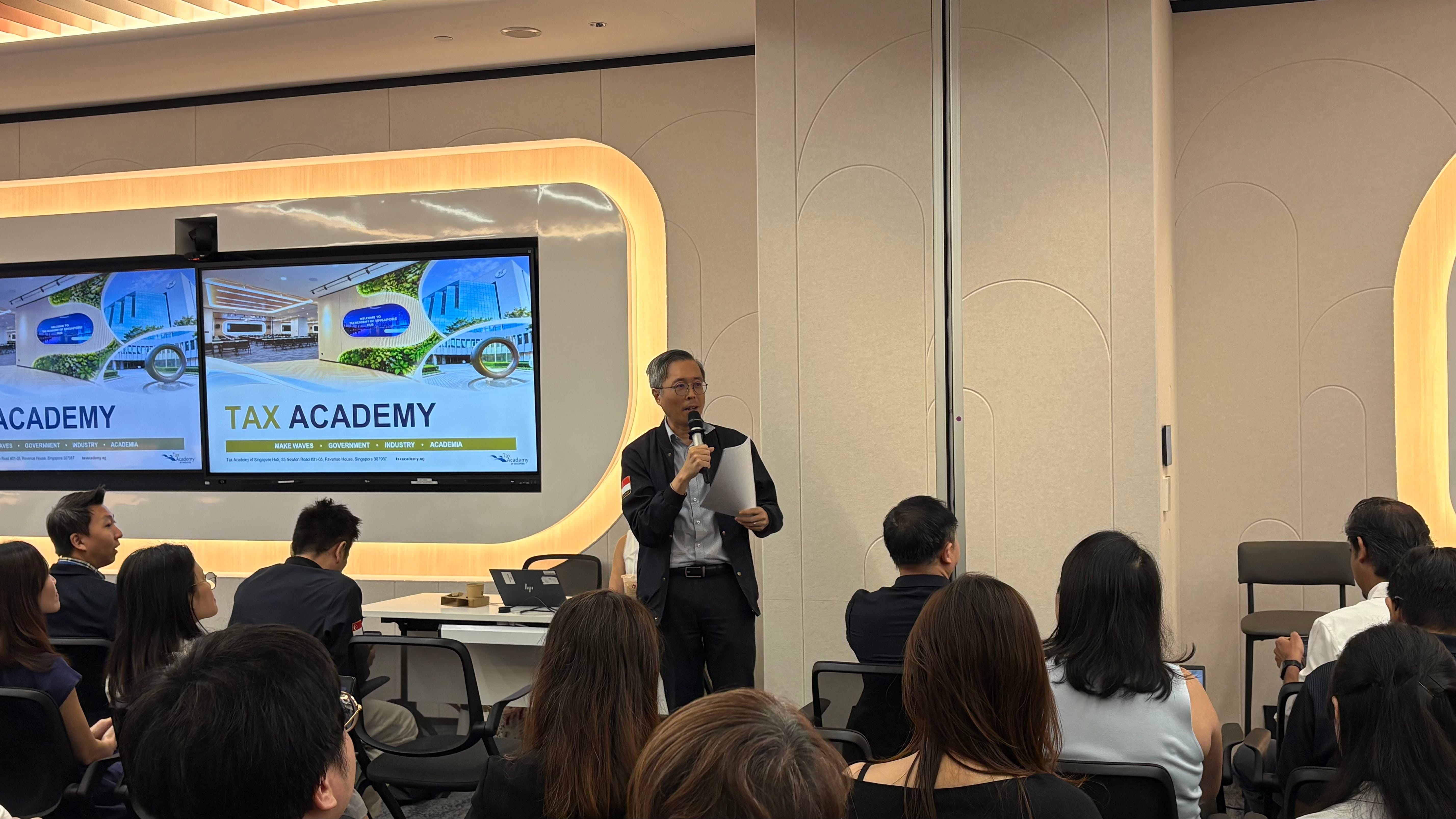
CEO Tax Academy, Mr Dennis Lui, giving the Welcome Speech at QSMC Forum 2026
Mr Dennis Lui
Chief Executive Officer, Tax Academy of Singapore
Deputy Commissioner (Indirect Taxes, Law & Investigation Group),
Inland Revenue Authority of Singapore