
International Tax at a Crossroads: Taxing Rights, Legal Certainty and Global Coordination
16 October 2026
From market-country taxation after Pillar One to international tax nexus, VAT/GST in multiparty transactions, European tax jurisprudence and global minimum taxation, the IFA–TA International Tax Conference 2026 examined the evolving relationship between taxing rights, legal principles and international coordination.
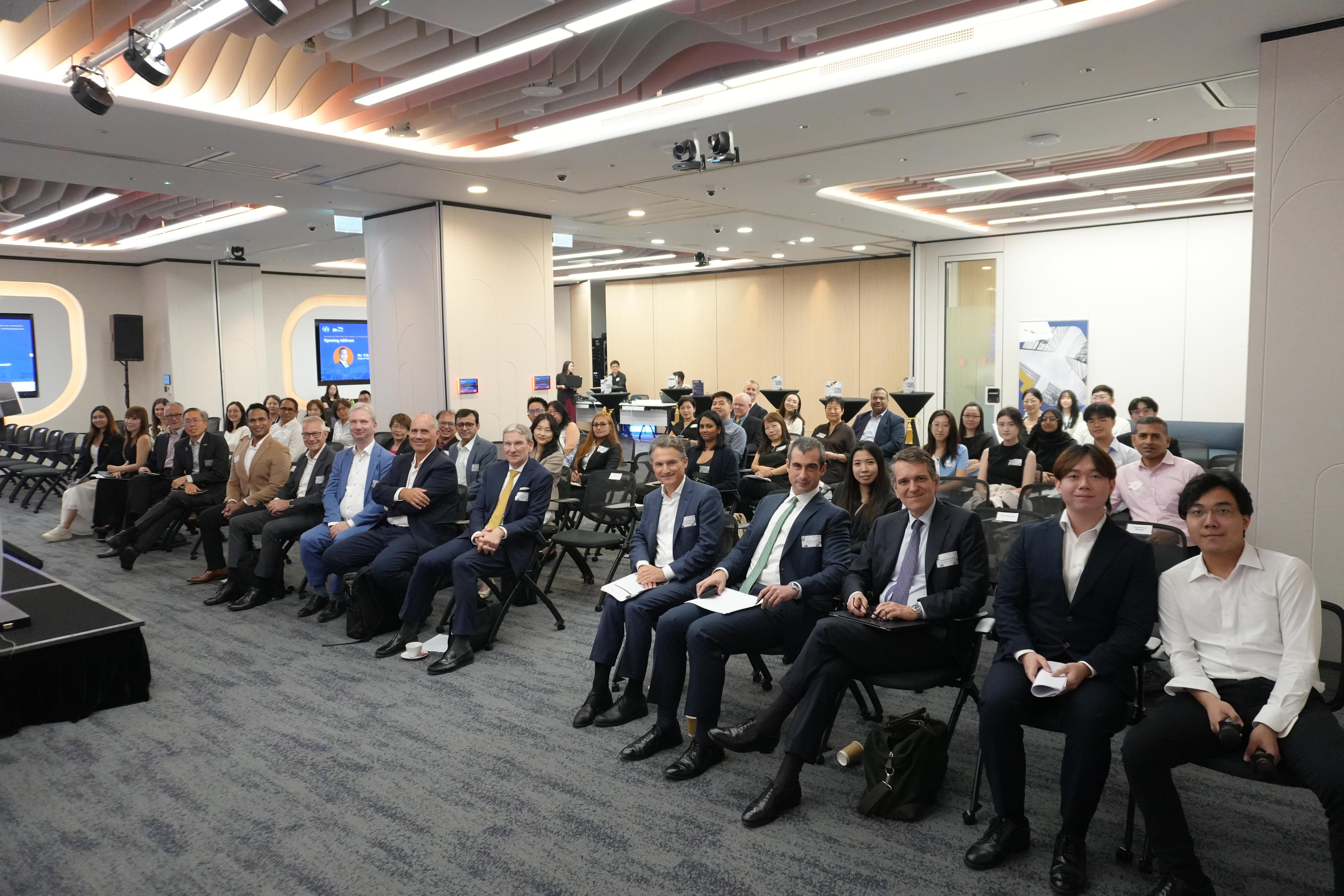
Group photo at the IFA-TA Conference 2026
International taxation has long involved balancing the taxing claims of different jurisdictions. Yet this challenge is becoming increasingly complex as businesses operate across borders, countries reconsider how taxing rights should be allocated, and international reforms interact with established domestic tax systems.
What gives a jurisdiction the right to tax an economic activity? How should overlapping taxing claims be managed? And how can international tax frameworks remain workable when countries have different economic interests, legal traditions and policy priorities?
These questions emerged throughout the IFA–TA International Tax Conference 2026, jointly organised by the Tax Academy of Singapore (TA) and the International Fiscal Association (IFA) Singapore (opens in new tab) on 16 October 2026.
Across five technical sessions and accompanying panel discussions, international scholars and practitioners explored developments ranging from the future of Pillar One and the legal foundations of tax nexus to indirect taxation, European court decisions and global minimum taxation.
Although the discussions approached international tax from different perspectives, they repeatedly returned to a common challenge: establishing clear and defensible taxing rights while managing the increasing interaction between national tax systems.

Prof. Dr. Wolfgang Schön delivering the keynote address
Market-Country Taxation: What Comes After Pillar One?
A central question in international taxation concerns the allocation of taxing rights between jurisdictions where businesses are established and those where their customers or markets are located.
Pillar One Amount A was developed as part of the OECD/G20's efforts to reconsider how taxing rights over certain profits of the largest and most profitable multinational enterprises should be allocated to market jurisdictions. Its future has become a subject of considerable debate, alongside the continued development of other approaches to market-country taxation.
In his keynote address, Market Country Taxation after Pillar One, Prof. Dr. Wolfgang Schön of the Max Planck Institute for Tax Law and Public Finance, Munich, examined the prospects for market-country taxation amid uncertainty surrounding Pillar One Amount A.
Rather than focusing solely on multilateral initiatives, he drew attention to approaches already being adopted by jurisdictions through domestic legislation and bilateral arrangements. These include withholding taxes on certain cross-border payments, taxation of services, digital services taxes and other measures associated with market-country taxation.
His analysis highlighted the possibility that market-country taxation could continue developing through multiple national and bilateral approaches, even in the absence of a comprehensive multilateral solution under Amount A.
This raises an important question: Could increasingly fragmented approaches to market-country taxation create greater complexity for cross-border businesses?

Group Photo of Panellists for Market Country Taxation after Pillar One. From left to right: Prof. Dr. Wolfgang Schön, Mr Ignacio Gepp, Mr Vineet Rachh, and Mr Mukesh Butani (on screen).
The panel discussion also demonstrated that the future of Pillar One remains a matter of debate.
While Prof. Schön expressed scepticism about the prospects for Amount A, other perspectives, including those from market jurisdictions, suggested that it would be premature to dismiss the initiative entirely.
The exchange reflected a broader tension between recognising the interests of market jurisdictions and maintaining the predictability needed to facilitate international investment and commerce.
Market-country taxation also involves economic trade-offs. Greater taxing rights may generate revenue for market jurisdictions, but the design and extent of taxation can also influence investment decisions, transaction costs and the distribution of economic burdens.
The discussion therefore moved beyond whether market jurisdictions should receive additional taxing rights to the more difficult question of how those rights should be established, coordinated and exercised.

Prof. Dr. Pasquale Pistone presenting on Public International Law and the Establishment of International Tax Nexus
International Tax Nexus: What Gives a Country the Right to Tax?
Before determining how profits should be allocated, a more fundamental question must be considered: What connection between a jurisdiction and an economic activity is sufficient to justify taxation?
This question formed the basis of Public International Law and the Establishment of International Tax Nexus, presented by Prof. Dr. Pasquale Pistone, Academic Chairman, International Bureau of Fiscal Documentation (IBFD).
Drawing on research undertaken within the International Law Association, Prof. Pistone examined how principles of public international law may inform the exercise of taxing jurisdiction.
The discussion explored the concept of an adequate connection between a state and the subject matter it seeks to tax, alongside considerations of sovereignty, international cooperation and the interests of other affected jurisdictions.
These questions have become increasingly relevant as cross-border business activity challenges traditional understandings of physical presence and economic connection.
The session also considered whether the development of new international tax measures should be evaluated against broader principles of public international law.
An example discussed was the Undertaxed Profits Rule (UTPR) under Pillar Two, which raises questions about the circumstances in which one jurisdiction may impose additional tax in relation to profits associated with activities elsewhere.

Panellists for Public International Law and the Establishment of International Tax Nexus. From left to right: Prof. Dr. Pasquale Pistone, Prof. Dr. Rene Matteotti, Ms Ng Chun Ying, and Assoc Prof Darren Koh
The panel reflected differing interpretations of the extent to which public international law constrains a state's exercise of taxing jurisdiction. While some perspectives considered whether economic effects and competition-related considerations could support particular taxing claims, others questioned whether these connections would be sufficient to justify the reach of measures such as the UTPR.
These were presented as questions of legal interpretation rather than settled conclusions.
A further issue concerned the relationship between formal legal principles and practical implementation.
International coordination may help reduce conflicting tax claims, but rules must also be capable of being understood, administered and enforced. A framework that is theoretically comprehensive may not necessarily be effective if its complexity creates substantial practical difficulties.
The discussion highlighted the continuing relevance of public international law to international tax policy, particularly as jurisdictions seek to reconcile domestic taxing sovereignty with increasingly interconnected economic activities.

Prof. Stephen Phua on VAT/GST in Tripartite Transactions
VAT/GST in Tripartite Transactions: Who Receives the Supply?
The question of identifying the appropriate taxpayer or taxable transaction is not confined to corporate income taxation.
In VAT/GST in Tripartite Transactions, Prof. Stephen Phua of the Faculty of Law, National University of Singapore, examined the challenges that arise when commercial arrangements involve more than two parties.
Traditional VAT/GST analysis often begins with a relatively straightforward transaction between a supplier and a customer. Modern commercial arrangements, however, may involve intermediaries, sponsors, loyalty programme operators, platforms and other parties whose roles are not easily reduced to a single buyer-seller relationship.
For example, one party may pay for a service performed for another party, while receiving a separate commercial benefit from the arrangement.
In such circumstances, identifying who makes a supply, who receives it and whether the payment relates to one or more supplies can become particularly challenging.
Prof. Phua examined these issues through case law involving third-party payments, commercial benefits and the recovery of input tax. His presentation considered how contractual rights and the economic substance of transactions may affect the identification of supplies.
A key question was whether the payment of consideration, or the receipt of an indirect commercial benefit, is sufficient to establish that a taxable supply has been made to the payer.

Panellists for VAT/GST in Tripartite Transactions. From left to right: Prof. Stephen Phua, Mr Ignacio Gepp, Ms Lee Jia Hua, and Ms Gan Hwee Leng.
The subsequent panel discussion brought additional perspectives from tax administration and professional practice.
The discussion highlighted the importance of examining contractual arrangements, the nature of the supplies and the underlying commercial circumstances. For input tax recovery, these considerations must also be assessed against the applicable statutory requirements, including whether goods or services have been supplied to the claimant and whether the relevant business-use conditions are satisfied.
The panel also distinguished between cases where input tax recovery may be unavailable because the required supply relationship has not been established and situations where specific legislative restrictions apply.
Although participants expressed different interpretations of certain cases, the exchanges highlighted the importance of examining the actual arrangement rather than relying solely on who makes a payment or benefits commercially.
For tax professionals, the session illustrated why multiparty transactions require careful analysis of contractual relationships and the supplies that actually take place.

Panellists for Recent Relevant ECJ Decisions and Trends for Non‑EU Investors. From left to right: Prof. Dr. Rene Matteotti, Mr Aurelio Massimiano, Ms Belinda Chan, and Mr Paul Lau.
European Tax Developments: Why Non-EU Investors Should Pay Attention
Tax developments within the European Union can have implications beyond its member states, particularly for businesses and investors with cross-border holdings, financing arrangements and investment structures.
In Recent Relevant ECJ Decisions and Trends for Non-EU Investors, Mr Aurelio Massimiano, Partner, Maisto e Associati, Milan, examined developments in European tax policy and jurisprudence through several interconnected topics.
The discussion addressed proposed simplification measures, transfer pricing and State aid, beneficial ownership, anti-abuse principles, and the VAT treatment of certain transfer pricing adjustments.
One area of focus was the interaction between national tax laws and EU State aid rules.
The panel considered how decisions involving multinational enterprises and national tax rulings illustrate the importance of identifying the relevant domestic legal framework when assessing whether a tax measure constitutes State aid.
This demonstrated that even within a highly integrated legal environment, domestic tax rules remain significant in determining the treatment of particular arrangements.
Another area concerned beneficial ownership and the prevention of abuse.
The discussion examined European court decisions involving intermediary holding structures, dividend and interest payments, and the application of anti-abuse principles.
For investors outside the EU, these developments raise questions about how investment structures may be assessed, including the legal and commercial significance of intermediary entities and transactions further along an ownership chain.
Panellists also considered the wider implications of regulatory complexity for investment decisions.
While measures aimed at addressing abuse and preserving fair competition pursue important policy objectives, the discussion highlighted the need to consider their interaction with existing tax rules and the compliance obligations faced by businesses.
The session illustrated a broader challenge in international taxation: legal certainty depends not only on the existence of tax rules, but also on how different legal frameworks interact and how those rules are interpreted in specific circumstances.
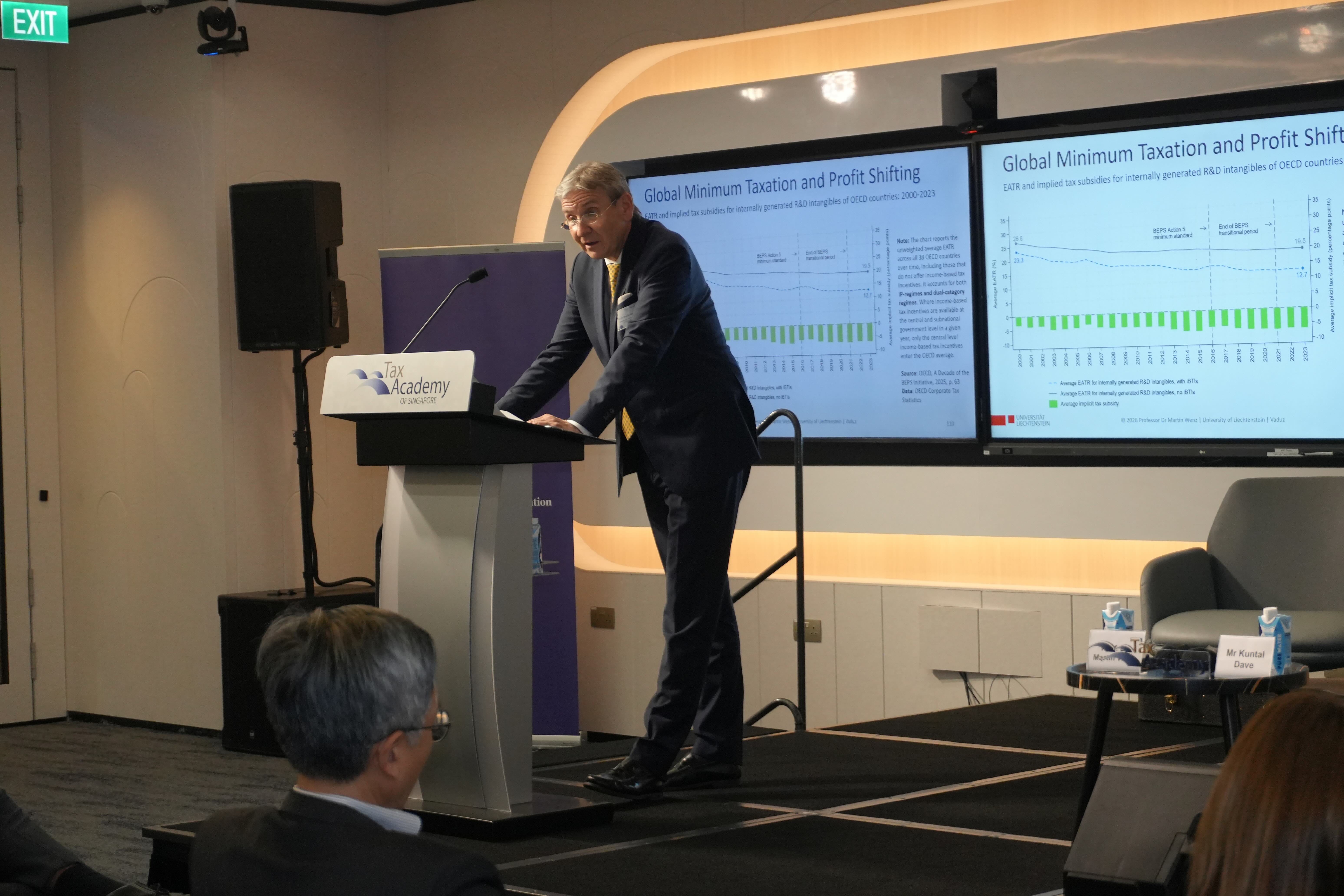
Prof. Dr. Martin Wenz on Global Minimum Taxation and Profit Shifting
Global Minimum Taxation: What Can the Evidence Tell Us?
Global minimum taxation represents another significant development in international tax coordination.
Under the OECD/G20 Pillar Two framework, the Global Anti-Base Erosion (GloBE) Rules establish a coordinated system of top-up taxation intended to ensure that in-scope multinational enterprise groups are subject to a minimum effective tax rate of 15% on a jurisdictional basis.
However, understanding the implications of global minimum taxation requires examining both the design of the rules and the evidence used to assess multinational profit allocation.
In his presentation, Global Minimum Taxation and Profit Shifting – empirical vs. regulatory analyses of CbCR-Data and GloBE-Rules under the SbS-System, Prof. Dr. Martin Wenz of the University of Liechtenstein, Vaduz, explored the relationship between empirical analyses of Country-by-Country Reporting (CbCR) data and the regulatory framework established under the GloBE Rules.
The discussion considered how CbCR data may be used to study the geographical distribution of multinational profits, taxes and economic activity.
At the same time, Prof. Wenz highlighted the methodological challenges involved in interpreting empirical findings.
Differences in accounting approaches, reporting practices and the underlying characteristics of multinational groups can affect how such data should be understood.
The discussion therefore raised questions about what can reasonably be inferred from reported profit and tax figures, and the limitations of using particular indicators as evidence of profit shifting.
A related issue concerned the role of economic substance in the global minimum tax framework, including the treatment of substance-based exclusions and the interaction between minimum taxation and investment incentives.

Panellists of Global Minimum Taxation and Profit Shifting. From left to right: Prof. Dr. Martin Wenz, Mr Kuntal Dave, and Mr Kwan Chang Yew.
The panel also examined the practical consequences of Pillar Two for multinational enterprises and tax administrations.
Participants considered the implications of the Side-by-Side (SbS) system, introduced under the January 2026 agreement of the OECD/G20 Inclusive Framework. The discussion raised broader questions about the interaction between different national tax systems, the treatment of multinational groups under the revised framework, and the balance between international coordination and domestic tax policy choices.
From a business perspective, the discussion emphasised the complexity of compliance, the need to interpret extensive technical rules and the possibility of differences in how jurisdictions administer a common international framework.
For policymakers, the questions extended to the relationship between minimum taxation, investment competitiveness and the continued use of domestic tax measures.
The exchanges demonstrated that evaluating global minimum taxation involves more than considering the headline minimum rate. It also requires attention to empirical evidence, regulatory design, economic substance and administrative feasibility.
For Singapore, Pillar Two has already become part of the domestic tax framework through the implementation of the Multinational Enterprise Top-up Tax (MTT) and Domestic Top-up Tax (DTT) for financial years beginning on or after 1 January 2025.
Singapore has not implemented the UTPR, whose implementation remains for later consideration. Singapore has also announced its implementation approach for the Side-by-Side package agreed by the Inclusive Framework in January 2026.
These developments provide an important distinction between the international policy and legal questions examined at the conference and the tax rules currently applicable in Singapore.
Five Discussions, One Continuing Challenge
Viewed together, the five sessions offer several recurring themes through which to understand the evolving international tax landscape. These themes reflect the range of issues discussed, rather than a common position adopted by the speakers or panellists.
First, taxing rights require a defensible basis. Whether the issue concerns market-country taxation, international tax nexus or the identification of supplies under VAT/GST, determining when and how a jurisdiction may impose tax remains fundamental.
Second, international coordination does not eliminate differences between national systems. Tax treaties, multilateral frameworks and common standards operate alongside domestic legislation, legal interpretation and administrative practice.
Third, legal and economic analysis must be supported by an understanding of the underlying facts. From contractual relationships in multiparty transactions to beneficial ownership, transfer pricing and empirical profit-shifting data, the quality of the analysis depends on how accurately the relevant circumstances are identified and evaluated.
Finally, the design of tax rules must be considered alongside their practical implementation. Complexity, compliance requirements and differing national approaches can affect how effectively international tax frameworks achieve their intended objectives.
These themes do not point to a single answer about how international taxation should evolve. Rather, they illustrate why different legal, economic, policy and practical perspectives remain important to the development of workable tax systems.
Continuing the International Tax Dialogue
The IFA–TA International Tax Conference 2026 reinforced the value of bringing academic research, tax administration perspectives and professional experience into the same conversation.
As international tax frameworks continue to evolve, understanding individual rules remains essential. Equally important is understanding the underlying policy choices, legal foundations and practical considerations that shape how those rules operate.
Through partnerships with organisations such as IFA Singapore, the Tax Academy of Singapore seeks to support informed discussion, strengthen professional capability and contribute to a deeper understanding of the issues facing the international tax community.
Editorial note: This article draws on presentations and panel discussions at the IFA–TA International Tax Conference 2026, jointly organised by the Tax Academy of Singapore and IFA Singapore on 16 October 2026. It summarises selected academic and professional perspectives shared during the conference. The views discussed should not be taken as official policy positions or legal guidance from the Tax Academy of Singapore, the Inland Revenue Authority of Singapore (IRAS), or other organisations represented by the speakers.
Related Reading
IFA–TA International Tax Conference 2026 – Conference Programme
Opening Remarks by Mr Dennis Lui, CEO of Tax Academy of Singapore
IRAS – Global Anti-Base Erosion (GloBE) Rules and Domestic Top-up Tax (opens in new tab)