
From Cross-Border Tax Disputes to Greater Certainty: MAP, Arbitration and APAs
2 September 2026
Session 5 of the Rosenbloom Masterclass explored how Mutual Agreement Procedures, mandatory arbitration and Advance Pricing Arrangements can help prevent and resolve cross-border tax disputes.

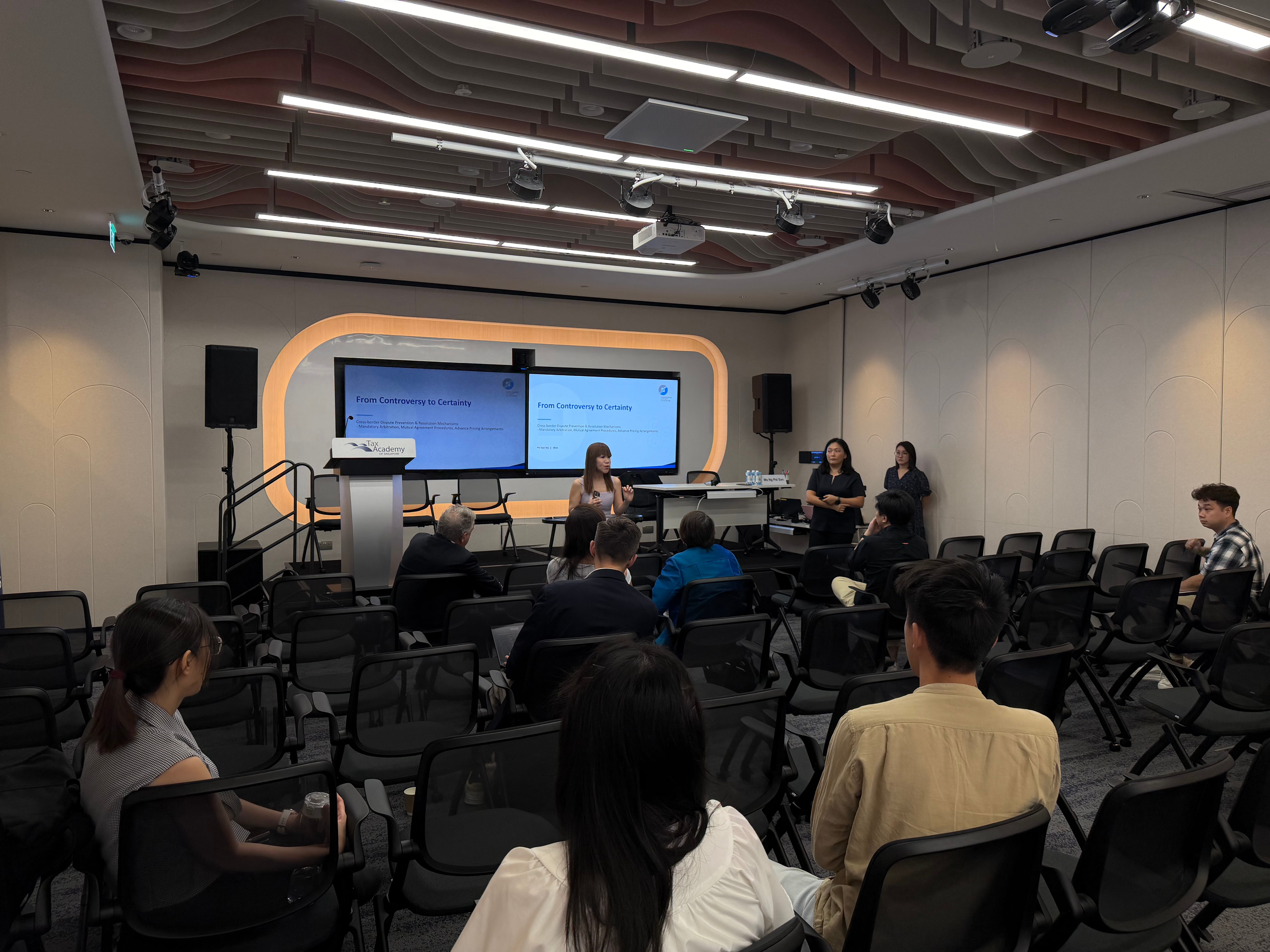
Ms Ng Pei San conducting Session 5 of the Masterclass.
This Perspectives & Insights article draws on Session 5: (AM) Treaties - Advanced Topics of the Masterclass with Professor David Rosenbloom and Professor Dr René Matteotti (opens in new tab), held on 2 September 2026.
Watch on TaxWatch (opens in new tab).
Cross-border tax disputes can extend well beyond the immediate amount of tax in question. They can create uncertainty over financial statements and future transactions, require significant management time and professional resources, and potentially result in the same economic profits being taxed in more than one jurisdiction.
For taxpayers operating across multiple jurisdictions, the question is therefore not only how a dispute can be resolved after it arises, but also how uncertainty can be managed before it develops into a dispute.
This was the focus of Session 5: (AM) Treaties – Advanced Topics, held on 2 September 2026 as part of the Masterclass with Professor David Rosenbloom and Professor Dr René Matteotti (opens in new tab). The session was led by Ms Ng Pei San, Tax Director (International Tax and Relations – Policy Branch) at the Inland Revenue Authority of Singapore (IRAS). The session examined Mutual Agreement Procedures (MAPs), arbitration and Advance Pricing Arrangements (APAs), with discussion focused on how these mechanisms can help taxpayers and tax authorities manage cross-border tax uncertainty.
The session was framed around a central theme: moving “from controversy to certainty” through mechanisms for both resolving and preventing cross-border tax disputes. As Ms Ng explained, MAPs, APAs and arbitration share a common objective of converting uncertainty into a more manageable and predictable tax outcome.
Mutual Agreement Procedures provide a framework for resolving cross-border disputes
A central theme of the session was the role of the Mutual Agreement Procedure (MAP) in resolving cross-border tax disputes. MAP is a mechanism provided under tax treaties through which the competent authorities of the jurisdictions concerned can consult each other to resolve cases where taxation may not accord with the applicable treaty.
Ms Ng highlighted that MAP is fundamentally a government-to-government process between competent authorities. It operates independently of domestic legal or administrative remedies available to a taxpayer, meaning that pursuing MAP does not simply amount to another level of domestic appeal.
An important practical consideration discussed during the session was that the timing and circumstances in which MAP is invoked matter. While MAP is intended to address treaty-related taxation issues, taxpayers must consider the requirements of the relevant treaty and applicable administrative guidance when determining whether a case is appropriate for MAP.
Arbitration can provide a backstop where MAP reaches an impasse
The session also considered arbitration as a potential backstop where competent authorities are unable to resolve an issue through MAP within the period specified under the applicable treaty.
Ms Ng explained that arbitration can provide a further mechanism for addressing unresolved issues, particularly where the treaty contains a mandatory binding arbitration provision. Under Singapore’s treaty framework, such provisions exist in some Double Tax Agreements (DTAs). Where the relevant conditions are met, an unresolved issue may be submitted to an arbitration panel following a specified period if the taxpayer makes the required request. The resulting decision is generally binding on the competent authorities, subject to the terms of the applicable treaty.
The broader point emerging from the discussion is that arbitration is not necessarily the first step in resolving a cross-border dispute. Rather, it can operate as a further layer of protection within the treaty framework where competent authorities are unable to reach agreement through MAP.
APAs move the focus from resolving disputes to preventing them
While MAP and arbitration primarily address disputes that have arisen, the session also examined Advance Pricing Arrangements (APAs) as a means of preventing transfer pricing disputes before they occur.
An APA is an arrangement through which the tax authority and taxpayer, or the tax authorities of the relevant jurisdictions, agree in advance on the criteria to be applied in determining the transfer pricing of specified related-party transactions over a defined period. In Singapore, IRAS recognises three types of APA: unilateral, bilateral and multilateral APAs. (See: IRAS: Advance Pricing Arrangement (opens in new tab))
Ms Ng discussed how bilateral and multilateral APAs can be particularly relevant where transactions span multiple jurisdictions. By involving the competent authorities of the jurisdictions concerned, these arrangements can provide greater certainty over the transfer pricing treatment of cross-border transactions and reduce the likelihood of disputes arising later.
The discussion therefore placed APAs within a broader continuum of tax certainty. Rather than waiting for a transfer pricing adjustment to generate a dispute, taxpayers may, where appropriate, seek agreement in advance on how particular transactions should be treated.
Ms Eunice Toh, Associate Director of Tax Academy of Singapore, introducing Ms Ng Pei San ahead of the session.
Critical assumptions can determine whether an APA remains appropriate
At the same time, the session emphasised that an APA is not necessarily suitable for every business or transaction.
A key consideration is the critical assumptions underpinning an APA. These assumptions may relate to matters such as the taxpayer’s business model, functions performed, assets used and risks assumed in relation to the covered transactions. Where there are significant changes to these underlying circumstances, the continued applicability of the APA may need to be reconsidered.
This is particularly relevant for businesses operating in environments where transactions, ownership structures or commercial arrangements can change rapidly. As discussed during the session, significant changes in a business or its operating model may affect whether an APA remains an appropriate mechanism for achieving tax certainty.
The practical implication is that seeking certainty in advance does not remove the need for taxpayers to monitor their circumstances continuously. The effectiveness of an APA depends, in part, on whether the facts and assumptions underlying the arrangement continue to reflect the taxpayer’s actual business operations.
Back-to-back unilateral APAs can provide a route towards greater bilateral tax certainty
The session also explored the use of two back-to-back unilateral APAs as a possible means of pursuing greater tax certainty for cross-border transactions.
As discussed by Ms Ng, this approach involves obtaining a unilateral APA in each of the two jurisdictions concerned, with the arrangements addressing the same cross-border transactions from the perspective of each jurisdiction. In this way, two unilateral arrangements can be used to pursue greater consistency in the tax treatment of the transactions across the jurisdictions involved.
Facts and documentation remain central to tax certainty
Beyond the mechanisms themselves, one of the clearest practical messages from the session was the importance of facts and documentation.
Ms Ng emphasised that transfer pricing analysis is ultimately grounded in the facts of the taxpayer’s business. This includes understanding the functions performed, assets used and risks assumed by the parties, as well as how the parties actually conduct themselves in practice.
The session also touched on the importance of documentation and the need to ensure that contractual arrangements are consistent with the commercial reality of the transactions. While an intercompany agreement may provide an important starting point, the actual conduct of the parties remains relevant in assessing the substance of the arrangement.
For taxpayers considering dispute prevention or resolution mechanisms, the practical lesson is therefore straightforward: tax certainty depends not only on choosing the appropriate mechanism, but also on having a sufficiently robust factual and documentary foundation.
Tax certainty extends beyond MAP and APAs
The session also considered other developments that form part of the broader tax certainty landscape, including the International Compliance Assurance Programme (ICAP) and the OECD’s Amount B framework.
ICAP is a voluntary risk assessment and assurance programme involving tax administrations and multinational enterprise groups. IRAS has participated in ICAP since 2021 and describes it as an additional tool that can facilitate cross-border tax certainty. Unlike an APA, however, ICAP does not provide the same degree of legal certainty. (See: IRAS: International Compliance Assurance Programme (opens in new tab))
Amount B represents another effort to simplify transfer pricing for certain baseline marketing and distribution activities. The OECD describes the Amount B approach as a simplified and streamlined framework for determining the remuneration of in-scope distributors. (See: OECD: Pillar One – Amount B (opens in new tab))
In Singapore, IRAS is implementing the simplified and streamlined approach on a pilot basis from 1 January 2026 to 31 December 2028, with the approach being optional for qualifying transactions.
Together, these developments illustrate that tax certainty is not confined to a single dispute resolution mechanism. Rather, it encompasses a range of tools that seek to reduce uncertainty, prevent disputes where possible and provide avenues for resolution when disagreements arise.
From controversy to certainty
The overarching message from Session 5 was reflected in its movement “from controversy to certainty”. MAP and arbitration provide mechanisms for addressing cross-border disputes, while APAs and other cooperative approaches can help taxpayers and tax administrations manage uncertainty before it develops into a dispute.
For taxpayers, however, the availability of these mechanisms does not eliminate the importance of early assessment, careful structuring and strong documentation. Understanding the relevant treaty provisions, identifying potential areas of disagreement and ensuring that the documented position reflects the commercial reality of the business can all contribute to more effective dispute prevention and resolution.
The discussion at the Masterclass therefore offered a practical perspective on an increasingly important aspect of international taxation: tax certainty is not simply about resolving disputes after they arise, but about building processes and practices that can reduce uncertainty from the outset.
Continue the conversation
Registration remains available through TaxWatch (opens in new tab) until 5 September 2026.
Readers who register during the eligible period can catch up on eligible completed sessions through available recordings, and retain access to eligible recordings and notes until 31 December 2026, subject to the applicable access arrangements.
TaxWatch registration (opens in new tab) closes on 5 September 2026.