
International Tax Policy Between National Sovereignty and Global Coordination
31 August 2026
Professor H. David Rosenbloom examines how domestic taxing rights, digitalisation, Pillar Two and dispute resolution expose a central tension in international tax: national systems increasingly depend on workable cross-border coordination.
This Perspectives & Insights article draws on Professor David Rosenbloom’s session, “The Making of International Tax Policy: Core Considerations and the Essential Structure”, delivered as part of the Tax Academy of Singapore’s Masterclass with Professor David Rosenbloom and Professor Dr René Matteotti.

Prof David Rosenbloom with Tax Academy of Singapore CEO, Mr Dennis Lui.
International Tax Policy Between National Sovereignty and Global Coordination
International tax increasingly appears to operate through a global architecture: multinational enterprises span jurisdictions, tax treaties connect national systems, information moves between administrations, and initiatives such as the OECD/G20 Two-Pillar Solution seek coordinated responses to common challenges.
Yet beneath this architecture lies a more fundamental reality. Taxes are still imposed under domestic law. Countries decide whom they tax, what they tax, how they define income and entities, and how their rules apply to activity crossing their borders.
That tension between national taxing sovereignty and international coordination formed a central thread in the opening session of the Tax Academy of Singapore’s Masterclass with Professor David Rosenbloom and Professor Dr René Matteotti, held from 31 August to 2 September 2026. The session, The Making of International Tax Policy: Core Considerations and the Essential Structure, was led by Professor H. David Rosenbloom, a longstanding international tax practitioner and academic who retired in May 2025 as James S. Eustice Visiting Professor of Taxation and Director of the International Tax Program at New York University School of Law.
Across a wide-ranging discussion—from the basic design of tax systems to digitalisation, Pillar Two, the Side-by-Side package, international institutions and transfer pricing—Professor Rosenbloom repeatedly returned to a deceptively simple question: what exactly requires international coordination, and what should remain a matter for national tax systems?
International tax begins with domestic choices
Before considering treaties, multinational groups or global minimum taxation, Professor Rosenbloom began with the foundations of tax policy.
A tax system must first determine who the taxpayer is, what constitutes taxable income, and how different legal and economic arrangements should be treated. Entity classification was one example explored in detail: whether an entity is treated as separate from its owners or as fiscally transparent can significantly affect tax outcomes, particularly when two jurisdictions classify the same arrangement differently.
The broader point was methodological. Cross-border tax questions do not arise in isolation from domestic tax systems. They emerge because countries have made their own choices about taxpayers, income, residence, source, entities and deductions—and those choices interact when economic activity crosses borders.
Professor Rosenbloom put the proposition more sharply during the session: rather than thinking of international tax as a single body of law sitting above national systems, it may be more useful to understand much of it as domestic rules governing cross-border taxation, supplemented by mechanisms through which countries coordinate those rules.
This framing helps explain why international tax can be difficult even where countries broadly agree on objectives. Coordination does not remove the underlying domestic systems. It has to operate through them.
Coordination matters because national systems collide
Once income, investment or business activity crosses borders, different domestic claims can overlap.
One jurisdiction may seek to tax on the basis of residence. Another may assert taxing rights because income arises within its territory. Entity classifications may diverge. The timing or characterisation of income may differ. A transaction recognised one way in one jurisdiction may be treated differently elsewhere.
Tax treaties are one mechanism for managing such interactions. Professor Rosenbloom highlighted in particular the enduring significance of the OECD Model Tax Convention as a template around which bilateral tax treaties could develop. The OECD’s first Draft Double Taxation Convention on Income and Capital was published in 1963, and the Model has since become an important benchmark for the negotiation, application and interpretation of tax treaties.
This illustrated a form of international cooperation that Professor Rosenbloom viewed favourably: developing common concepts, templates and approaches that jurisdictions can adopt through their own legal and treaty processes.
The distinction became important later in the session. His concern was not with international cooperation itself, but with how far international institutions should move from facilitating coordination towards shaping substantive domestic tax outcomes.
That question now sits near the centre of debates over the international tax architecture.
Digitalisation tests whether existing principles remain sufficient
The taxation of the digital economy provided one example.
Digitalisation has made it increasingly possible for businesses to participate economically in a market without the physical presence traditionally associated with income-tax nexus. The OECD’s Pillar One Amount A was developed to address this issue by allocating a portion of the profits of the world’s largest and most profitable multinational enterprises to market jurisdictions, including where those enterprises may lack a conventional physical presence.
Professor Rosenbloom questioned whether digitalisation necessarily requires fundamentally new income-tax principles. His discussion drew a distinction between concerns over corporate income-tax nexus and taxes directed more directly at consumption or market activity, and he was sceptical of the political prospects for Amount A, particularly given the importance of United States participation.
That scepticism should be understood as his assessment of the initiative rather than a statement that the OECD has formally abandoned Pillar One. The Multilateral Convention implementing Amount A has been developed, but Amount A has not entered into force. Meanwhile, Amount B has been incorporated into the OECD Transfer Pricing Guidelines and implementation work continues.
The discussion therefore raised a broader question extending beyond digital taxation: when economic change places pressure on existing international tax concepts, how should policymakers decide whether to adapt those concepts, create new ones, or address the underlying policy concern through another part of the tax system?
Pillar Two shows how international coordination can shape incentives
The discussion of the Global Anti-Base Erosion, or GloBE, rules brought the sovereignty-and-coordination tension into particularly sharp focus.
Under Pillar Two, in-scope multinational enterprise groups are generally subject to a minimum effective tax rate of 15% calculated on a jurisdictional basis. The framework includes the Income Inclusion Rule (IIR), the Undertaxed Profits Rule (UTPR) and qualified domestic minimum top-up taxes, which allow jurisdictions to impose additional tax where the relevant effective tax rate falls below the minimum.
Professor Rosenbloom characterised an important feature of this architecture through the language of incentives. If the jurisdiction in which low-taxed profits arise does not impose the relevant top-up tax, the structure may allow another jurisdiction to collect additional tax through the coordinated GloBE rules.
In the session, he compared the resulting dynamic to a form of “prisoner’s dilemma”: a jurisdiction may formally retain the sovereign ability to impose a lower rate, but its decision has to be considered against the possibility that another jurisdiction may collect the resulting top-up tax.
Whether one accepts that characterisation or not, it identifies an important change in international tax coordination. Pillar Two does more than establish a shared template. Its interconnected rules can affect the incentives facing jurisdictions and multinational groups across different domestic systems.
The discussion also examined the Side-by-Side package, agreed by the OECD/G20 Inclusive Framework in January 2026. Among other elements, the package creates a Side-by-Side Safe Harbour under which qualifying groups headquartered in jurisdictions with eligible regimes may be relieved from the IIR and UTPR in other implementing jurisdictions. Qualified domestic minimum top-up taxes remain unaffected. The United States has been recognised as having an eligible Side-by-Side regime from 1 January 2026.
Professor Rosenbloom was openly uncertain about the longer-term implications. He questioned whether the accommodation could create materially different outcomes for US-parented groups and whether such compromises could ultimately weaken the durability of Pillar Two.
Those were forward-looking assessments rather than settled conclusions. They nevertheless expose an important issue for international tax policy: a coordinated framework must remain politically acceptable to the jurisdictions on whose continued participation it depends.
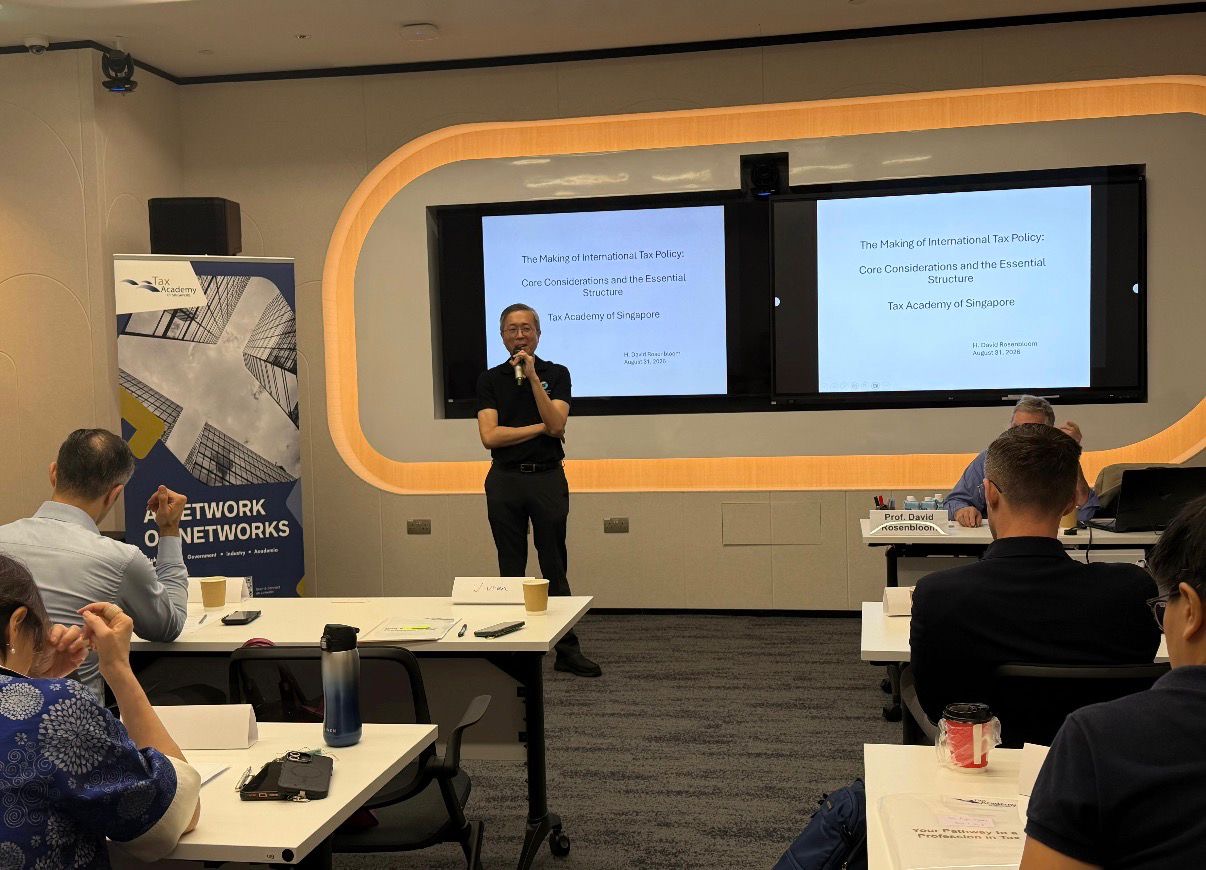
Mr Dennis Lui, CEO of Tax Academy of Singapore, Introducing Prof. David Rosenbloom ahead of the session.
Singapore shows how international agreements become domestic architecture
For Singapore, these questions are already practical rather than theoretical.
Singapore implemented the Multinational Enterprise Top-up Tax and Domestic Top-up Tax for financial years beginning on or after 1 January 2025. The rules generally apply to multinational enterprise groups with annual consolidated revenue of at least €750 million in at least two of the four preceding financial years. Singapore has not yet implemented the UTPR.
Following the January 2026 agreement, Singapore has also announced its intention to amend its legislation and regulations to implement relevant components of the Side-by-Side package, subject to the legislative process.
Importantly, the Side-by-Side arrangement does not remove Singapore’s Domestic Top-up Tax. The Ministry of Finance has stated that large multinational groups operating in Singapore—including US multinational enterprises—remain subject to Singapore’s minimum effective tax rate of 15% on their Singapore profits where the Domestic Top-up Tax applies.
This illustrates the interaction at the heart of the session. International agreement may establish the architecture, but the architecture becomes operational through domestic legislation, administration and taxpayer compliance.
For tax professionals, understanding international developments therefore requires more than reading the international agreement itself. It requires following how each jurisdiction translates that agreement into its own legal system.
Dispute resolution and information exchange are part of the infrastructure
Despite his scepticism about some forms of international rule-making, Professor Rosenbloom did not suggest that countries could operate independently.
Towards the end of the session, he identified two particularly important foundations for workable international tax cooperation: exchange of information and effective dispute resolution.
The emphasis is significant.
Increasing coordination can also generate increasingly complex interactions between national systems. Even where jurisdictions follow common standards, they may interpret facts differently, apply rules differently or assert competing taxing rights. Without mechanisms for resolving those disagreements, coordination at the level of rule design does not necessarily produce certainty for taxpayers.
Singapore’s tax treaty framework provides for the Mutual Agreement Procedure (MAP), through which IRAS and the competent authority of another treaty jurisdiction can seek to resolve cases involving taxation not in accordance with an applicable tax agreement. IRAS describes MAP as part of its commitment to tax certainty. Singapore also participates in international arrangements supporting exchange of information for tax purposes.
The subject is also prominent in the ongoing United Nations negotiations on a Framework Convention on International Tax Cooperation. Negotiations are taking place over 2025–2027, with one of two early protocols specifically addressing the prevention and resolution of tax disputes.
Professor Rosenbloom expressed considerable scepticism about the UN process during the session. His comments reflected concerns about participation, technical capacity and whether emerging international arrangements can command sufficient acceptance to work effectively in practice.
Whatever view is taken of particular institutions, the underlying issue is difficult to avoid: as tax systems become more interdependent, mechanisms for resolving the consequences of that interdependence become increasingly important.
Transfer pricing shows how coordination can still produce mismatches
The final part of the session offered a preview of Professor Rosenbloom’s subsequent discussion of transfer pricing.
Even where jurisdictions broadly accept the arm’s-length principle, domestic procedural rules can still produce mismatches.
Using the United States as an example, Professor Rosenbloom examined the relationship between the amount actually charged in a controlled transaction and the amount ultimately reported for tax purposes. US rules permit a taxpayer, in specified circumstances, to report a controlled transaction on a timely filed original return using an arm’s-length result different from the price actually charged. The US transfer-pricing regime also contains extensive contemporaneous-documentation requirements relevant to certain transfer-pricing penalties.
The problem becomes international when the counterparty jurisdiction does not recognise the corresponding adjustment. What appears as a domestic compliance or pricing issue can therefore become a question of double taxation, secondary adjustments and ultimately competent-authority dispute resolution.
It was a fitting point on which to close the session: common principles do not remove the need to understand how individual legal systems apply them.
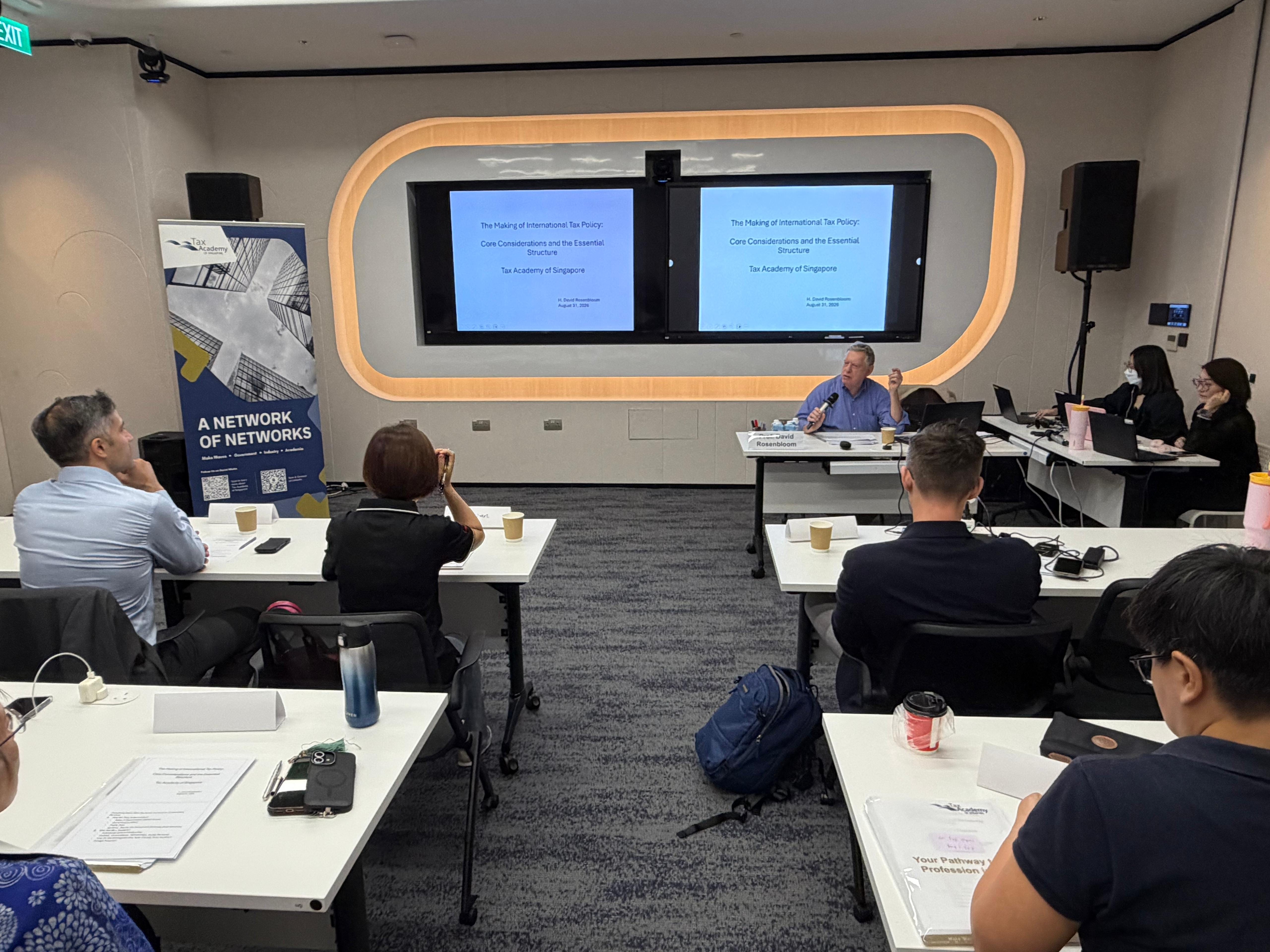
Prof. David Rosenbloom giving his lecture
What international tax policy increasingly requires
The discussion ultimately offered less a prescription for a particular international tax system than a way of thinking about one.
When confronted with a new international tax proposal, several prior questions matter. What policy problem is being addressed? Which jurisdiction claims the right to tax? How does the rule interact with existing domestic systems? What information must administrations exchange? What happens when two countries disagree? And will the institutions supporting the arrangement retain sufficient acceptance for the framework to endure?
From treaties to digitalisation, Pillar Two and transfer pricing, international tax increasingly involves countries attempting to coordinate systems that remain fundamentally national.
That makes international cooperation more important, not less. But it also means that effective cooperation depends on the interaction between technical design, domestic implementation, administration, dispute resolution and political legitimacy.
For tax professionals, policymakers and businesses, understanding those interactions may be just as important as understanding the rules themselves.
Continue learning on TaxWatch
The Masterclass with Professor David Rosenbloom and Professor Dr René Matteotti continues through 2 September 2026.
Registration remains available through TaxWatch until 5 September 2026. Participants who register during the eligible period can join applicable remaining sessions live, catch up on completed sessions through available recordings, and continue accessing eligible recordings and resources until 31 December 2026, unless otherwise stated.
Explore the Masterclass (opens in new tab) and TaxWatch.