
Resolving International Tax Disputes: Arbitration, APAs and Other Approaches
2 September 2026
Professor David Rosenbloom examined international tax dispute resolution, from Mutual Agreement Procedures and mandatory arbitration to Advance Pricing Arrangements, mediation and investment treaty arbitration, and the pursuit of greater tax certainty.
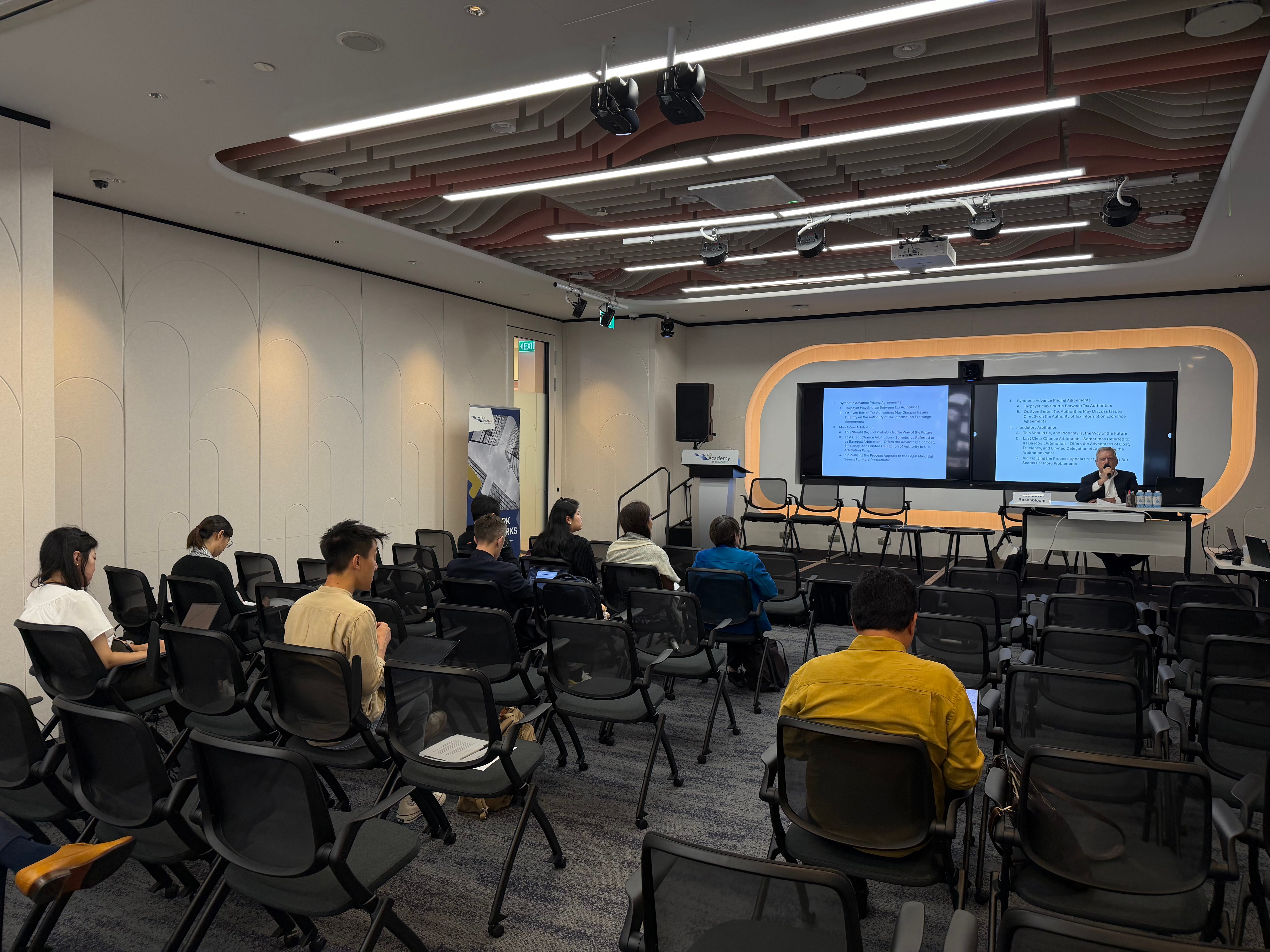
Professor Rosenbloom conducting the final session of the Masterclass.
This Perspectives & Insights article draws on Session 6: (PM) Major current International Tax Issues of the Masterclass with Professor David Rosenbloom and Professor Dr René Matteotti (opens in new tab), held on 2 September 2026.
Watch on TaxWatch (opens in new tab).
International tax certainty is not only about how taxing rights are allocated between jurisdictions. It also depends on whether taxpayers and tax administrations have effective mechanisms to prevent, manage and resolve disagreements when cross-border transactions give rise to different positions.
This was a central theme of Session 6: (PM) Major Current International Tax Issues, the sixth and final session of the Masterclass with Professor David Rosenbloom and Professor Dr René Matteotti (opens in new tab), held by the Tax Academy of Singapore on 2 September 2026. Professor David Rosenbloom, formerly of NYU School of Law and former International Tax Counsel at the U.S. Treasury, considered several current international tax issues, with particular attention to how cross-border tax disputes can be addressed.
Rather than viewing dispute resolution as a matter that arises only after a disagreement has crystallised, the session considered a broader continuum: preventing disputes where possible, providing structured avenues for negotiation, and establishing mechanisms that can bring disputes to a conclusion where negotiations reach an impasse.
Liberty Global and the challenge of resolving complex tax disputes
Professor Rosenbloom opened the session with the U.S. Liberty Global litigation and the economic substance doctrine. The case concerned transactions undertaken by Liberty Global in connection with the international tax provisions of the 2017 U.S. Tax Cuts and Jobs Act. On 21 April 2026, the U.S. Court of Appeals for the Tenth Circuit issued a published decision in Liberty Global v. United States, addressing the application of the codified economic substance doctrine to the transactions at issue. (See: U.S. Court of Appeals for the Tenth Circuit: Liberty Global v. United States (opens in new tab))
For Professor Rosenbloom, the significance of the litigation extended beyond the immediate dispute. He used the case to consider broader questions surrounding tax-motivated transactions and the role of anti-abuse doctrines. The discussion provided a starting point for considering how international tax disputes can be managed once taxpayers, tax administrations and courts take different positions on complex transactions.
That question becomes particularly important where a dispute involves two or more jurisdictions whose taxing claims may overlap. Treaty-based dispute-resolution mechanisms provide a framework through which jurisdictions can seek to address such disagreements.
Mandatory arbitration can provide a backstop to MAP
Mutual Agreement Procedure (MAP) is a treaty-based mechanism through which competent authorities seek to resolve cases where taxation is considered not to have been in accordance with the applicable tax treaty. IRAS describes MAP as a dispute-resolution facility under Singapore's tax treaties. Some Singapore treaties also contain mandatory binding arbitration provisions for issues that remain unresolved after the applicable MAP period, subject to the conditions of the relevant treaty. (See: IRAS: Mutual Agreement Procedure (MAP) and Arbitration (opens in new tab))
Professor Rosenbloom placed particular emphasis on the role that mandatory arbitration can play when competent authorities reach a stalemate. Drawing on his experience with U.S. treaty arbitration, he discussed a last-best-offer approach in which an arbitration panel selects between the positions presented by the parties rather than constructing an entirely new settlement.
His broader point was that the value of arbitration may extend beyond cases that actually reach a panel. In his view, the existence of a defined endpoint can encourage competent authorities to negotiate seriously and reach agreement before arbitration becomes necessary.
The OECD's 2026 Manual on Effective Mutual Agreement Procedures (MEMAP) similarly provides guidance on MAP arbitration and discusses different approaches to arbitration decision-making, including last-best-offer and independent-opinion approaches. (See: OECD: Manual on Effective Mutual Agreement Procedures, 2026 Edition (opens in new tab))
Tax treaties provide more than rules for allocating taxing rights
The discussion also highlighted the broader role of tax treaties. In addition to allocating taxing rights between jurisdictions, treaties can establish mechanisms through which jurisdictions address disagreements over the application or interpretation of treaty provisions.
For Singapore, this includes MAP and, in selected treaties, mandatory binding arbitration. IRAS notes that arbitration can apply to unresolved issues after the relevant MAP period where the applicable treaty contains an arbitration provision and the necessary conditions are satisfied. (See: IRAS: Mutual Agreement Procedure (MAP) and Arbitration (opens in new tab))
Professor Rosenbloom therefore encouraged consideration of dispute resolution alongside the development of substantive international tax rules. In his discussion of newer international tax arrangements, including Pillar Two, he questioned whether the effectiveness of new rules should also be considered in light of the mechanisms available when jurisdictions subsequently disagree over their application.
The broader international framework continues to develop in this area. The OECD's 2026 MEMAP provides practical guidance for competent authorities on making MAP more effective, including guidance relating to arbitration and the resolution of treaty disputes. (See: OECD: Manual on Effective Mutual Agreement Procedures, 2026 Edition (opens in new tab))
APAs shift the focus from resolving disputes to preventing them
The session also examined Advance Pricing Arrangements (APAs), which move the focus further upstream — from resolving an existing dispute to reducing the likelihood of one arising in the first place.
IRAS describes an APA as a dispute-prevention facility under which IRAS and the taxpayer, or the relevant treaty partner, agree in advance on criteria for determining the pricing of related-party transactions for a specified period. Singapore provides for unilateral, bilateral and multilateral APAs. (See: IRAS: Advance Pricing Arrangements (APAs) (opens in new tab))
Professor Rosenbloom recognised the value of APAs, particularly in transfer pricing, but raised a more fundamental question concerning the resources required to administer them. APAs can require substantial technical work and engagement between taxpayers and tax administrations. His discussion therefore considered whether the certainty provided to individual taxpayers should always justify the administrative resources required to deliver it.
The discussion consequently placed APAs within a wider continuum of tax certainty: disputes can be prevented in advance through arrangements such as APAs, managed through MAP when disagreements arise, and potentially brought to arbitration where a treaty provides for it.
Mediation raises different questions in the international context
Professor Rosenbloom also considered mediation as another possible approach to dispute resolution. Drawing on his experience with mediation in the U.S. domestic tax context, he described circumstances in which mediation had helped parties narrow their differences and reach a settlement.
He was more cautious about applying the same approach to international tax disputes. Domestic tax mediation operates within a single legal and administrative system, whereas international MAP involves competent authorities from different jurisdictions operating under treaty obligations and separate domestic frameworks.
The distinction raises a broader question about whether techniques that work effectively in domestic dispute resolution can be transferred directly to the international sphere. In Professor Rosenbloom's discussion, the absence of a clear consequence if international mediation fails was an important consideration.
Investment treaty arbitration introduces a different set of considerations
Another part of the discussion examined bilateral investment treaty (BIT) arbitration and how tax disputes can sometimes intersect with international investment law.
Professor Rosenbloom distinguished investment treaty arbitration from arbitration under tax treaties. Although both may involve arbitration, they arise from different legal frameworks and relationships.
This distinction has practical significance. UNCTAD's research shows that tax-related measures have been involved in investor-State dispute settlement cases brought under international investment agreements. Its research identifies cases including Cairn v. India, which concerned tax-related measures. (See: UNCTAD: Facts on Investor–State Arbitrations in 2021: With a Special Focus on Tax-Related ISDS Cases (opens in new tab))
Professor Rosenbloom used the Cairn dispute to question whether investment treaty arbitration is an appropriate mechanism for resolving tax disputes. His assessment was critical of the cost and complexity of such proceedings, while acknowledging that investment treaty protections could potentially have a role in exceptional circumstances involving serious government conduct.
More broadly, the existence of overlapping tax and investment-law frameworks highlights the importance of considering how different international legal mechanisms interact when governments introduce or enforce tax measures.
The broader challenge is managing disagreement
Across the different mechanisms discussed, a common theme emerged: international tax certainty is not synonymous with the absence of disputes.
The more practical objective is to ensure that disputes can be prevented where possible, negotiated effectively when they arise and, where necessary, brought to a credible conclusion. APAs can support dispute prevention. MAP provides a treaty-based framework for competent-authority negotiations. Mandatory arbitration can provide a further recourse where negotiations reach an impasse and the applicable treaty contains the necessary provision.
For businesses operating across borders, understanding these mechanisms is part of understanding the wider international tax environment. For tax professionals, the challenge extends beyond technical knowledge of individual rules to an appreciation of how taxpayers, competent authorities, treaties and dispute-resolution mechanisms interact.
Professor Rosenbloom's discussion ultimately returned to a fundamental question for international tax: what should happen when jurisdictions disagree? The answer is unlikely to lie in a single mechanism. Greater certainty may instead depend on having appropriate tools that can prevent disputes where possible, facilitate negotiation when differences arise and provide credible avenues for resolution when agreement cannot be reached.
As international tax cooperation continues to evolve, the effectiveness of these mechanisms will remain an important part of the broader architecture of cross-border taxation.
Continue learning on TaxWatch
Registration remains available through TaxWatch (opens in new tab) until 5 September 2026.
Readers who register during the eligible period can catch up on eligible completed sessions through available recordings, and retain access to eligible recordings and notes until 31 December 2026, subject to the applicable access arrangements.
TaxWatch registration (opens in new tab) closes on 5 September 2026.